Gemwood › How to play
How to play wood block puzzle: rules, scoring & 12 tips
Wood block puzzle is easy to learn and surprisingly deep. This guide covers the rules, how points and combos work in Gemwood: Wood Block Puzzle, what every special block does, and the strategies that help you score higher and beat more levels.
The basic rules
- The board is an 8×8 wooden grid.
- The tray under the board holds three blocks. Drag any of them onto the board. Blocks can't be rotated, so each one fits only the way it's shown.
- Clear lines: when a row or a column is completely full, it clears and frees that space.
- New blocks arrive once all three in the tray have been placed.
- Game over happens when none of the remaining blocks fit anywhere on the board.
How scoring works
Points come from clearing lines. Clearing more lines with a single block is worth much more than clearing them separately:
| Lines in one move | Base points |
|---|---|
| 1 line | 100 |
| 2 lines | 300 |
| 3 lines | 600 |
| 4 lines | 1,000 |
| 5 lines | 1,500 |
Combos
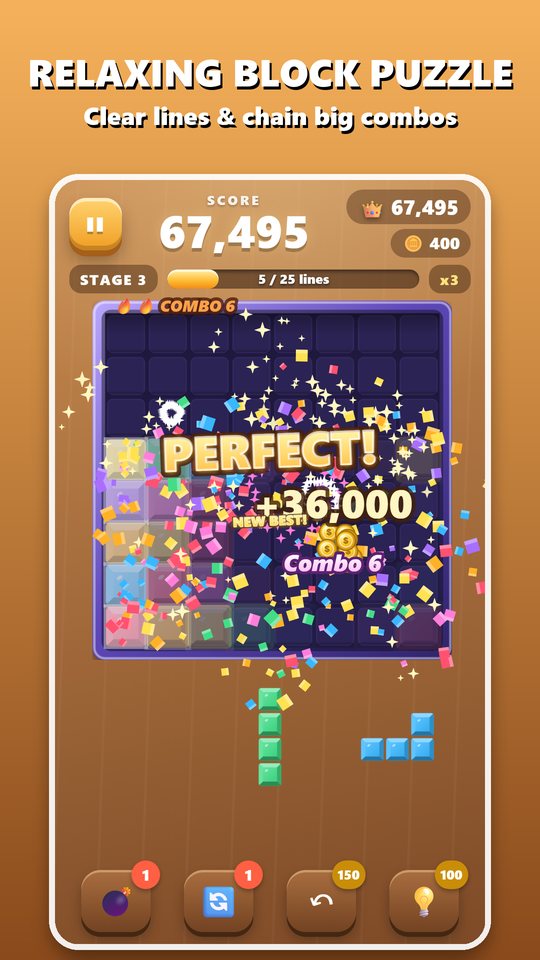
Every time you clear again within three moves, your combo goes up by one, and the line points are multiplied by the combo number. Keeping a combo alive for a whole tray of blocks is the fastest way to a high score.
Perfect clear
If a clear leaves the board completely empty, you get a Perfect bonus of 3,000 points on top.
Stages and multipliers
In Classic mode you move up a stage after clearing enough lines, and higher stages raise the score multiplier. Long, steady games pay off.
Game modes in Gemwood
- Classic: the endless block puzzle. Beat your best score.
- Adventure: 300 levels in 20 worlds — from Honey Woods and Jewel Caves to Lava Forge, Starlight Galaxy and Obsidian Throne. Each level has a goal, such as collecting gems, clearing a picture or reaching a score within a move limit.
- Daily challenge: a new puzzle every day, plus daily quests and a Brain Score that grows when you play smart.
Special blocks and obstacles
- 🧊 Ice needs two clears — the first one cracks it.
- 📦 Crates hide a gem. Clear their row or column to smash them open.
- ⛓ Chains need two clears — the first one breaks the chain.
- 💣 Bombs count down with every move. Clear their row or column before the counter reaches 0.
- 🪨 Stone is the toughest block and needs three clears.
Your own tools help in tight spots: the crush bomb clears a 3×3 area, new pieces swaps the tray, undo takes back a move and hint shows a good placement.
12 tips for higher scores
- Always leave room for the 3×3 square. It's the hardest block to fit. Keep at least one 3×3 gap open whenever you can.
- Leave room for the long 1×5 bar. Keep a full row or column nearly empty so the 5-long pieces have somewhere to go.
- Look at all three blocks before you place one. Plan the order: often the big piece should go first while there's still space.
- Fill edges and corners first. Pieces fit more easily against walls, and the middle stays flexible.
- Avoid single-cell holes. One empty cell surrounded by blocks can only be filled by the 1×1 piece — and it may never come.
- Set up double clears. Build two rows (or a row and a column) to one-short, then finish both with one block.
- Keep the combo alive. If you can clear a line every move or two, do it — even a small clear protects the combo.
- Don't rush big clears. A risky setup that blocks the board can end the game. A steady 2-line clear beats a failed 4-line plan.
- Keep the board low. Try to stay under about half full. Lots of open space means every block fits.
- Play obstacles early. In adventure levels, clear ice, chains and stone rows early — they take several clears.
- Watch bomb counters. Clear the bomb's row or column first, even if it isn't your best-scoring move.
- Save tools for emergencies. Use the crush bomb or new pieces when nothing fits — not just to score a bit more.
Watch it in action
Ready to try it?
Play Classic, the daily puzzle and the first 30 adventure levels free in your browser — or get all 300 levels on Android, playable offline.